Lake Biwa's designated National Cycle Route—affectionately known as "Biwaichi"—offers breathtaking waterfront vistas and diverse terrain. However, for first-time visitors and international cyclists, riding on Japanese public roads can bring questions: "Which side of the road should I be on?" or "How do I safely share the lane with cars?"
Thanks to Shiga Prefecture's extensive cycling infrastructure, understanding just a few fundamental rules makes navigating Lake Biwa safe, intuitive, and stress-free.
Here is a practical breakdown from a local cyclist on essential road rules, correct lane positioning, and how to follow Shiga's distinct "Blue Line."
1. The Golden Rule: Always Ride on the Left (Keep Left!)
Under Japanese traffic law, bicycles are classified as light vehicles. This means cyclists must ride on the left side of the road, following the same direction of travel as motor vehicles.
- Riding Against Traffic is Strictly Prohibited: Riding on the right side against oncoming traffic is an illegal and extremely dangerous maneuver that significantly raises the risk of head-on collisions. International cyclists accustomed to riding on the right must be particularly mindful to stay on the left at all times.
- Sidewalks are for Pedestrians: You may only ride on sidewalks if designated by specific cycling signage. Even then, pedestrians always have the right of way. Maintain a slow, controllable speed and be ready to stop immediately.
2. How to Read Shiga's "Blue Line" Markings
Throughout the Biwaichi circuit, blue navigational pavement markings are painted on the asphalt to guide cyclists along the recommended course. Whenever you feel unsure of your position, look for this blue guidance system.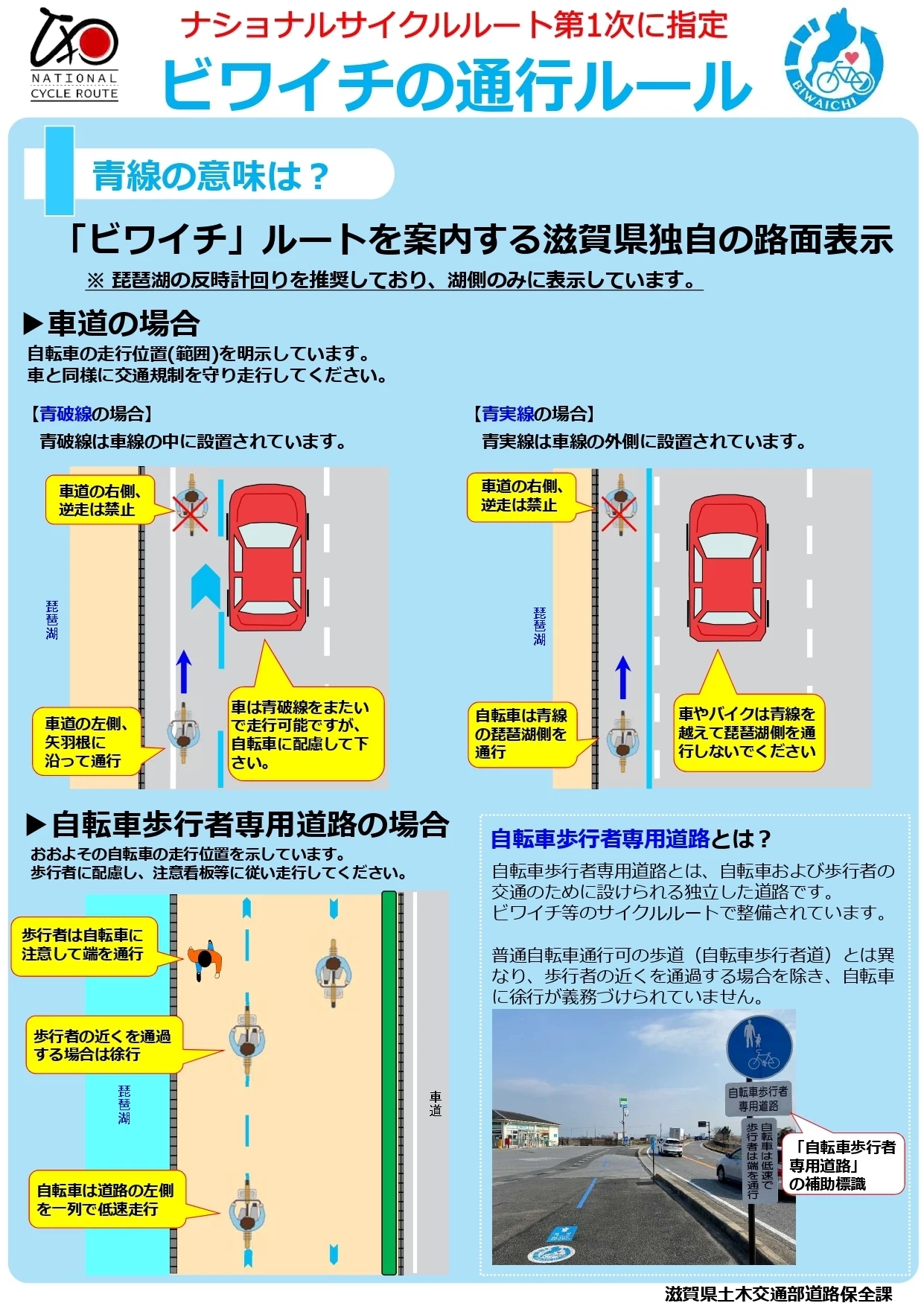
There are two primary styles of Blue Line markings:
① Blue Chevron Arrows (Shared Roadway) A series of blue chevron arrows painted along the left shoulder of the roadway.
- How to ride: Ride smoothly over or just inside these chevrons.
- Key takeaway: This space is shared with motor vehicles. Maintain a steady, straight line and avoid sudden swerving.
② Dedicated Solid Blue Line Lane A continuous blue line separating a cycling strip on the outer edge (lake side) of the roadway.
- How to ride: Stay inside the demarcated blue lane, closest to Lake Biwa.
- Key takeaway: This lane is protected from motor vehicles, offering a relaxed and scenic space to pedal without vehicle interference.
3. Where to Position Yourself When There is No Blue Line
On secondary roads or narrow sections without blue pavement markings, avoid riding directly against the curb or road gutter. Instead, position your wheels just slightly to the right of the solid white edge line (toward the traffic lane).
- Puncture Prevention: Debris such as glass shards, gravel, metal wire, and storm runoff naturally accumulates on the extreme left shoulder. Riding too close to the gutter drastically increases the risk of punctures. The area smoothed by car tires is significantly cleaner.
- Creating a Safety Buffer: If you hug the curb from the outset, you have zero room to maneuver when a bus or truck passes from behind. By holding a predictable line slightly further out, you maintain space to smoothly drift left to yield, clearly signaling your awareness while granting passing drivers ample clearance.
4. Courtesies on Dedicated Bike & Pedestrian Paths
Certain stretches of the Biwaichi route feature off-street paths shared exclusively by cyclists and pedestrians. While free from vehicular traffic, these paths are actively used by local residents for walking and running.
- Slow Down Around Pedestrians: Never buzz past walkers at high speed. Slow down, provide wide passing margins, and avoid excessive bell ringing.
- Single File Only: Never ride two or more abreast. Riding side-by-side blocks oncoming cyclists and pedestrians. Always maintain single-file formation on the left side of the path.
Summary: Ride Smart, Ride Safely
Navigating Biwaichi safely comes down to three clear principles: follow the Blue Line, keep left, and share the road with mutual courtesy.
By following these fundamental rules, you eliminate unnecessary hazards and can focus entirely on the open horizon, crisp lakeside air, and rich heritage of Lake Biwa. Enjoy a safe and memorable journey around the lake!